
Performance Parts Warranty Claims: Your Step-by-Step Process Guide

Last Updated: November 15, 2026
Quick Summary
To file performance parts warranty claims, confirm eligibility and identify the defect, contact the seller or warranty administrator for a claim number, then submit your claim with complete documentation and track its status weekly. Most delays come from missing documents rather than rejected claims, so build your file before you contact anyone.
- Warranties generally cover defects in materials or workmanship, not wear, damage, or bad tunes.
- Keep the failed part and do not ship it back until the administrator requests it in writing.
- Processing time runs from a few business days to several weeks once the file is complete.
- Escalate in writing one level at a time: seller, then warranty administrator, then manufacturer.
- A denial is not always final; read the written reason and appeal with documents addressing it.
Table of Contents
- Why Performance Parts Warranty Claims Get Complicated
- What Performance Parts Warranties Actually Cover
- How to File a Warranty Claim for Car Parts: The Full Process
- Your Warranty Claim Documentation Checklist
- Filling Out a Performance Parts Warranty Claim Form Correctly
- Automotive Warranty Claim Processing Time and What to Expect
- If Your Claim Is Denied: Escalation and Next Steps
- Start Your Claim with Axion Performance Parts
- Frequently Asked Questions
Why Performance Parts Warranty Claims Get Complicated
A performance parts warranty claims process guide matters because modified cars sit in a gray zone.
Claims are often lost for reasons unrelated to the part itself: a missing receipt, an unclear defect photo, or a call to the wrong department.
Three things make these claims harder than a stock replacement part:
- The part was installed by the owner, not a shop. No dealer paperwork exists, so you build the record yourself.
- The failure is often blamed on the tune. Sellers ask whether the part failed or the tune killed it.
- Warranty terms are written for stock vehicles. Coverage language often excludes "modified" or "racing" use, and the definition of racing is loose.
The process rewards preparation over speed: file fast, but file complete. Below: eligibility, documentation, submission, and what to do when a claim stalls.
What Performance Parts Warranties Actually Cover
Performance parts warranties generally cover defects in materials or workmanship rather than wear, damage, or the results of a bad tune. That distinction decides most claims.
A limited warranty is a written promise to repair or replace a part that fails because of how it was made. It does not guarantee the part will never fail or that the rest of the car is protected.
Defects in Materials vs. Workmanship Defects
A defect in materials means the metal, rubber, or electronics were flawed before the part was built. A workmanship defect means the part was assembled or machined wrong.
Examples:
- A turbo housing that cracks at a seam with no impact damage points to materials.
- A weld that fails on an exhaust hanger points to workmanship.
- A coilover that leaks after a pothole strike points to neither, and that claim usually fails.
The Performance-Part Problem: Defect vs. Consequential Damage
On a stock vehicle, a failed alternator is almost always an alternator claim. On a modified vehicle, the same failure can be argued three ways: the part was defective, the installation caused it, or the tune caused it.
Your claim is strongest when you separate the part failure from the vehicle damage. A turbo that seized with clean oil and no overboost log is a part claim.
How Modifications, Tuning, and Racing Use Affect Coverage
Warranty terms are written for stock vehicles, and performance parts sit outside that assumption. Language to look for:
- "Modified vehicle" exclusions. Some warranties void coverage if the vehicle has any aftermarket modification beyond the part itself. Others cover the part but exclude failures caused by other mods.
- Tuning and overboost clauses. A tune that raises boost beyond the part's rated range is the most common reason a turbo or intercooler claim is denied. Keep the tune file and datalogs; they are evidence either way.
- Racing and competition exclusions. Terms often exclude "racing," "competition," or "off-road use," and the definition is loose. A track day, an autocross, or a drag-strip pass can all be argued into that language. Read whether the exclusion is about the event or the driving conditions.
Watch out: assuming a "lifetime" label covers everything. Most limited warranties cover the part only, under stated conditions, and a lifetime label on a wear-prone component often means the part is replaced but labor, shipping, and related damage are not.
Exclusions Every Enthusiast Should Know
Read the warranty terms before you need them. Common exclusions:
- Wear items: pads, bushings, filters, gaskets
- Damage from improper installation or missing hardware
- Failures caused by an aggressive tune or overboost
The last three are where out-of-pocket costs hide. A warranty that replaces the part for free can still leave you paying for lift time, diagnosis, and freight, so price those before pursuing a claim.
How to File a Warranty Claim for Car Parts: The Full Process
The claim route depends on where you bought the part. A direct purchase goes to the seller. A shop install may route through the installer or an authorized repair facility. A used part usually has no coverage at all.
Recommended workflow:
- Confirm eligibility and identify the defect
- Contact the seller or warranty administrator
- Submit your claim and track its status
- Prepare for inspection or old-part return
- Follow up on approval or denial
Step 1: Confirm Eligibility and Identify the Defect
Start with the paperwork, not the phone. Find your sales receipt, part number, and repair date, then check the warranty terms for the coverage window and any exclusions.
If your order itself was wrong, sort that out first. Our guide on how to check performance parts order accuracy walks through matching the part number and hardware to what shipped.
Then describe the failure in plain terms: what happened, when, and under what conditions. "Turbo began smoking under load at 4,000 rpm after 6,000 miles" beats "turbo is broken."
Step 2: Contact the Seller or Warranty Administrator
Contact the seller first. They hold the claim record and know which administrator handles the brand. Ask three questions:
- Who reviews the claim?
- What documentation do you need from me?
- What is the expected response time?
Get the claim number in writing, by email if possible. A phone promise disappears. An email thread does not.
Step 3: Submit Your Claim and Track Its Status
Submit through the claims portal if one exists, or by email with attachments if not. Keep every submission confirmation.
Track the claim status weekly. Most delays come from missing documents, not rejected claims, so a short follow-up email can move things along.
Your Warranty Claim Documentation Checklist
Strong documentation is the difference between a claim review and a claim denial. Build the file before you contact anyone.
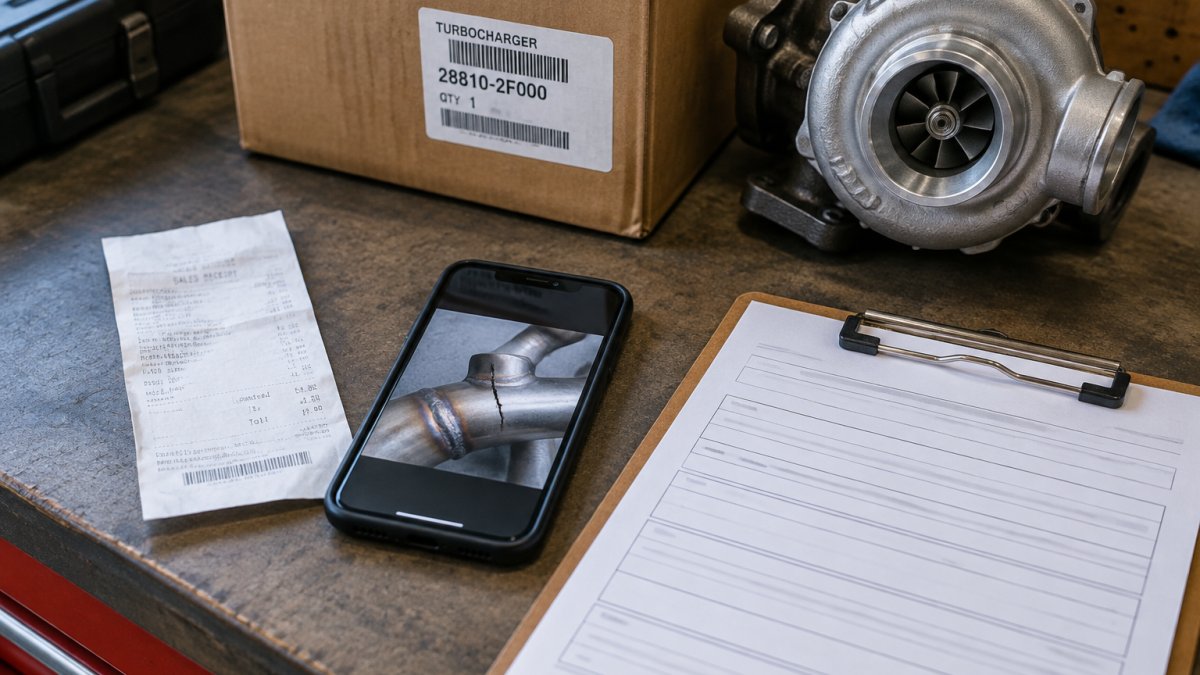
Use this checklist:
- Sales receipt or order confirmation showing the purchase date
- Part number and serial number, photographed on the part
- Vehicle identification number (VIN)
Keep the failed part. Do not throw it away, and do not ship it back until the administrator asks. Old-part return is often required before a replacement ships.
Filling Out a Performance Parts Warranty Claim Form Correctly
The performance parts warranty claim form is where good claims go to die. Most rejections trace back to a vague failure description or a missing part number.
Fill it out like a technician, not a customer:
- Part identification: copy the part number exactly from the box or the part itself. No shorthand.
- Failure description: state the symptom, the mileage, and the conditions. One or two clear sentences.
- Supporting documentation: attach photos and the receipt. Name each file clearly.
A common mistake is writing "defective part" and nothing else. That gives the reviewer nothing to verify. Describe what the part did wrong.
Automotive Warranty Claim Processing Time and What to Expect
Automotive warranty claim processing time usually runs from a few business days to several weeks. The clock starts when the administrator has a complete file, not when you first call, which explains most of the frustration enthusiasts report.
Expect these stages:
| Stage | Typical Timing | What Happens |
|---|---|---|
| Claim submission | Day 1 | You file with the seller or administrator |
| Acknowledgment | Days 1-5 | Claim number issued; document request may follow |
| Claim review | Days 2-10 | Reviewer checks coverage and documents |
| Defect analysis | Days 5-20 | Part may be inspected or returned |
| Approval or denial | After review | Written decision issued |
| Replacement or reimbursement | After approval | Part ships or refund is processed |
Timelines vary by manufacturer and by how complete your file is. A claim missing photos sits in review until you send them, and the review clock effectively restarts each time you add a document.
What to Do While You Wait
Most delays are document delays, not decision delays. Use the wait to strengthen the file rather than call for status updates:
- Photograph the failed part again from new angles, especially any markings, lot numbers, or date codes.
- Save the tune file and any datalogs that show boost, fuel, or timing behavior at the time of failure.
- Get a written diagnostic from a shop if you have not already; a scan-tool report with freeze-frame data is far stronger than a verbal description.
Watch out: shipping the part back before you have a written return authorization. Once the part is in the administrator's hands, your ability to document it independently is gone, and disputes over condition become your word against theirs.
Response Expectations and When to Escalate
Warranty claim response deadlines are set by the warranty document itself, so the warranty terms are the contract you enforce. Read it for stated response windows, then hold the administrator to them in writing.
Escalation ladder:
- Follow up in writing at the stated response window. Email, not phone, so the thread is preserved. Reference the claim number and the date you submitted.
- Ask for a status in writing if acknowledgment never arrived. A claim with no claim number is not really in the system.
- Escalate to a supervisor or the warranty administrator's manager if the stated window passes twice with no substantive response.
- Escalate to the manufacturer if the seller or administrator is unresponsive, and copy the seller on the message.
- Use your card issuer's dispute process if the part was bought on a credit card and the seller will not engage. This is a separate route from the warranty and has its own deadlines.
Keep every message factual and short. Reviewers respond to claim numbers and dates, not to frustration.
If Your Claim Is Denied: Reading the Reason and Appealing
A denial is not always final. Read the written reason first, because it tells you what to fix and whether an appeal is worth the effort.
Common denial reasons and responses:
- Missing documentation: resubmit with the receipt, photos, or installation record.
- Excluded use: ask the administrator to point to the specific warranty term and the evidence they relied on.
- Improper installation: provide the installer's notes, torque specs, or your own installation record.
Appeal in writing, one level at a time: seller, then warranty administrator, then the manufacturer. Reference the claim number and attach documents addressing the stated reason. If the denial cites a term you believe does not apply, quote it back and explain why.
If Your Claim Is Denied: Escalation and Next Steps
Common denial reasons and responses:
Then escalate in writing, one level at a time: seller, then warranty administrator, then the manufacturer. Keep the tone factual and reference your claim number each time. If the part was bought on a credit card, check whether your card issuer offers purchase protection, since that can be a separate route.
Start Your Claim with Axion Performance Parts
The claim process is mostly paperwork, and paperwork is where most enthusiasts lose. Build the file first, describe the failure clearly, and follow up in writing.
That is also how we handle support at Axion Performance Parts. Axion Performance Parts has been a provider of aftermarket performance parts since 2009, offering a curated selection of turbos, tuners, exhausts, and suspension upgrades, along with expert technical support for installations and modifications and fast shipping.
Search our store to find the performance parts you need, and contact us for current pricing or a quote.
Frequently Asked Questions
What are the steps involved in a performance parts warranty claim?
Confirm the part is still under warranty and the failure is a defect, not normal wear. Then gather your proof of purchase, installation records, part number, and photos of the failure. Contact the seller or warranty administrator to get a claim form, submit it with your documentation, and track the claim status until you receive approval, denial, or a request for inspection. Keep the failed part until the claim is resolved.
How long do automotive warranty claims take to process?
Processing time varies by manufacturer and claim complexity. Simple claims with complete documentation often move faster than claims requiring inspection or part return. Ask the warranty administrator for an expected timeline when you submit, and follow up if you have not heard back within that window. Missing documentation is the most common cause of delays, so submit everything at once.
Can modifications or installation affect my performance part warranty?
Yes. Improper installation, use outside the part's intended application, or related modifications that cause the failure can void coverage. Keep installation records from a qualified shop and follow the manufacturer's break-in and tuning guidance. If a tuner or supporting mod pushed the part beyond its rated limits, expect the claim to be scrutinized or denied.
What should I do if my warranty claim is denied?
Read the denial reason carefully and check whether it cites a specific exclusion. If you believe the decision is wrong, request a review in writing with additional evidence such as diagnostic findings or a second inspection. Escalate to the manufacturer if the seller cannot resolve it, and keep copies of all correspondence. Many denials stem from missing documentation, which can sometimes be corrected on appeal.


