
The Track-Day Guide to Upgrading Acura Integra Suspension

Last Updated: October 28, 2026
Quick Summary
Upgrading Integra suspension for track use means fixing the weakest link first, then adding adjustability only where you'll use it. Work through safety and wear, bushings, dampers and springs, sway bars, alignment, and testing in that order. The expensive coilover step sits in the middle, not at the top.
- Replace worn factory bushings before adjusting geometry, since tired rubber lets alignment settings move under cornering.
- A damper valved for an 8k spring won't control a 14k spring, so match rates to your damper.
- The SILVER'S NEOMAX 2-Way Coilovers are listed at $2,199.00 and fit the 5th Gen Integra 1.5T.
- The TEIN Flex Z Coilovers are listed at $1,235.00 with 16-way damping adjustment.
- Set alignment after every suspension change that affects ride height or geometry, and change one setting at a time.
Table of Contents
- Start With a Track-Ready Integra Suspension Plan
- Coilovers vs Springs and Shocks: What Actually Changes on Track
- The Best Coilovers for Acura Integra Track Duty
- Integra Coilover Spring Rates and Front-to-Rear Balance
- Acura Integra Suspension Bushings, Sway Bars and Supporting Mods
- Acura Integra Track Alignment Settings and Adjustment Trade-Offs
- Reading Tire Temperatures and Lap Times to Tune Your Setup
- Build Your Integra Track Suspension Package With Axion
- Frequently Asked Questions
Start With a Track-Ready Integra Suspension Plan
Upgrading Acura Integra suspension for track use starts with one principle: fix the weakest link first, then add adjustability only where you'll use it.
Most track-day guides treat suspension as a shopping list instead of a system. Coilovers, sway bars, bushings, alignment, and tires all interact, and changing one without the others leaves you chasing problems no single part can solve.
The plan below assumes a 5th Gen Integra.
| Stage | What You Change | Why It Comes Here | Typical Cost |
|---|---|---|---|
| 1. Safety and wear | Brake pads, fluid, tire condition | Nothing else matters if you can't stop | Low |
| 2. Bushings and mounts | Worn factory bushings, end links | Restores geometry before you adjust it | Low to mid |
| 3. Dampers and springs | Coilovers or spring/shock package | The core handling change | Mid to high |
| 4. Sway bars | Rear bar first, then front | Tunes balance after the base is set | Mid |
| 5. Alignment | Camber, toe, corner balance | Unlocks what the hardware can do | Low |
| 6. Testing | Tire temps, lap times, notes | Tells you what to change next | Free |
Notice that the expensive part sits in the middle, not at the top. That's deliberate.
Coilovers vs Springs and Shocks: What Actually Changes on Track
A coilover is a matched damper and spring assembly with adjustable ride height; a spring-and-shock package reuses separate components.
Lowering springs on factory dampers can work on the street, but on track the factory damper runs out of travel and control as heat builds.
That adjustability is the real argument. A coilover kit for the Integra platform lets you run a softer setting for the drive home and a firmer one for the session.
Watch out: buying lowering springs to save money and then adding a rear sway bar to "fix" the resulting handling usually makes the car nervous rather than faster.
The Best Coilovers for Acura Integra Track Duty
For 5th Gen owners considering coilovers, two options listed here fit the 5th Gen Acura Integra.
The SILVER'S NEOMAX 2-Way Coilovers are listed at $2,199.00 and fit the 5th Gen Acura Integra 1.5T.

The TEIN Flex Z Coilovers are listed at $1,235.00 and fit the 5th Gen Acura Integra.

Best for: NEOMAX for dedicated track cars, Flex Z for street-first builds that see occasional track days. Skip if: you're not going to adjust anything.
Integra Coilover Spring Rates and Front-to-Rear Balance
Integra coilover spring rates are usually expressed in kilograms per millimeter (kg/mm), and the front-to-rear split does more for handling balance than the absolute number. Stiffer springs at one end increase that end's share of roll resistance and change which axle loses grip first.
How to read a spring rate
A rate of 8 kg/mm means it takes 8 kilograms of force to compress the spring one millimeter. Most track-oriented Integra coilovers use linear springs because they're predictable at the limit; progressive springs ride better but are harder to read at the edge of grip.
Starting ranges by use case
These are starting points, not prescriptions. Tire choice, bar sizes, alignment, and driver preference all move the final number.
| Use case | Front rate (kg/mm) | Rear rate (kg/mm) | Notes |
|---|---|---|---|
| Street-first, occasional track day | 6-8 | 5-7 | Softer rear keeps the car stable on cold tires and in rain |
| Dual-purpose, regular track days | 8-10 | 8-10 | Equal or slightly rear-stiff biases rotation without snap |
| Dedicated track, sticky tires | 10-14 | 10-14 | Requires dampers valved for the rate and a matched bar package |
Start equal front and rear, then add rear rate only after the car is stable under braking and the driver can consistently hit the same lap time. Adding rear rate to an already-loose car just hides a setup problem.
Generation and trim fitment notes
Spring rate advice only makes sense when you know which Integra you have, since curb weight, geometry, and factory bar sizes differ across generations.
- 3rd Gen (DB/DC2): Lighter chassis with double-wishbone suspension front and rear. These cars respond well to moderate rates because the geometry is good and the weight is low. Many owners run 8k/8k to 10k/10k on track tires. Check that the coilover is listed for the DC2 specifically; some kits share part numbers with EG/EK Civics but use different top mounts.
- 4th Gen (DC5): Heavier than the DC2 and uses MacPherson struts in front, which changes camber behavior under load. Rates in the 8k/10k to 12k/12k range are common for track use. Confirm front camber plate compatibility, since the DC5 strut top differs from the DC2.
- 5th Gen (DE4/DE5, including Type S): The current chassis. The Type S ships with adaptive dampers, and replacing them with coilovers means addressing the factory damper control module, some kits include cancellation modules, some do not. Verify this before ordering. Rates in the 8k/8k to 10k/10k range suit dual-purpose cars; dedicated track builds often go stiffer in front to manage the heavier nose.
Match the rate to the damper
Before you change rates, check what your damper can control. A damper valved for an 8k spring won't control a 14k spring; the car will feel underdamped, oscillate over bumps, and lose grip in transitions. A BR Series coilover option for the RSX and Integra platform with adjustable damping gives you room to move rates within its valving range. On factory dampers, adding rate is usually a mistake.
Rates are a package, not a number
A common mistake is copying a spring rate from a forum post without knowing the poster's tire, bar, and alignment. A 12k/12k car on 200-treadwear tires with a big rear bar and -3 degrees of camber behaves nothing like the same rates on all-seasons with stock alignment.
If you change rates, change one end at a time and test. Going stiffer in front and rear simultaneously tells you nothing about which change helped.
Acura Integra Suspension Bushings, Sway Bars and Supporting Mods
Acura Integra suspension bushings are the quiet culprit behind vague handling on older cars. Consistent chassis feedback relies on this level of precision, which serves as a fundamental component of professional vehicle preparation for those seeking to maximize their Integra's performance on the track.
The Eibach 25mm Rear Sway Bar + Brace Kit is listed at $450.00 and fits the 5th Gen Acura Integra. Its listing describes a rear sway bar and brace kit.
SILVER'S NEOMAX 2-WAY COILOVERS →

Front sway bar links are worth inspecting at the same time. They're cheap, and a worn link makes a new bar feel inconsistent.
Don't overlook supporting work: fresh brake fluid and track-capable pads belong in the same conversation as suspension, because a car that stops consistently is one you can drive to the limit. Track-capable front brake pads for the Civic Type R and Integra let you actually use the grip you've added.
Acura Integra Track Alignment Settings and Adjustment Trade-Offs
Acura Integra track alignment settings trade grip against tire wear and stability, and no single number suits every driver. Here's a framework with a starting point and a reason for each number.
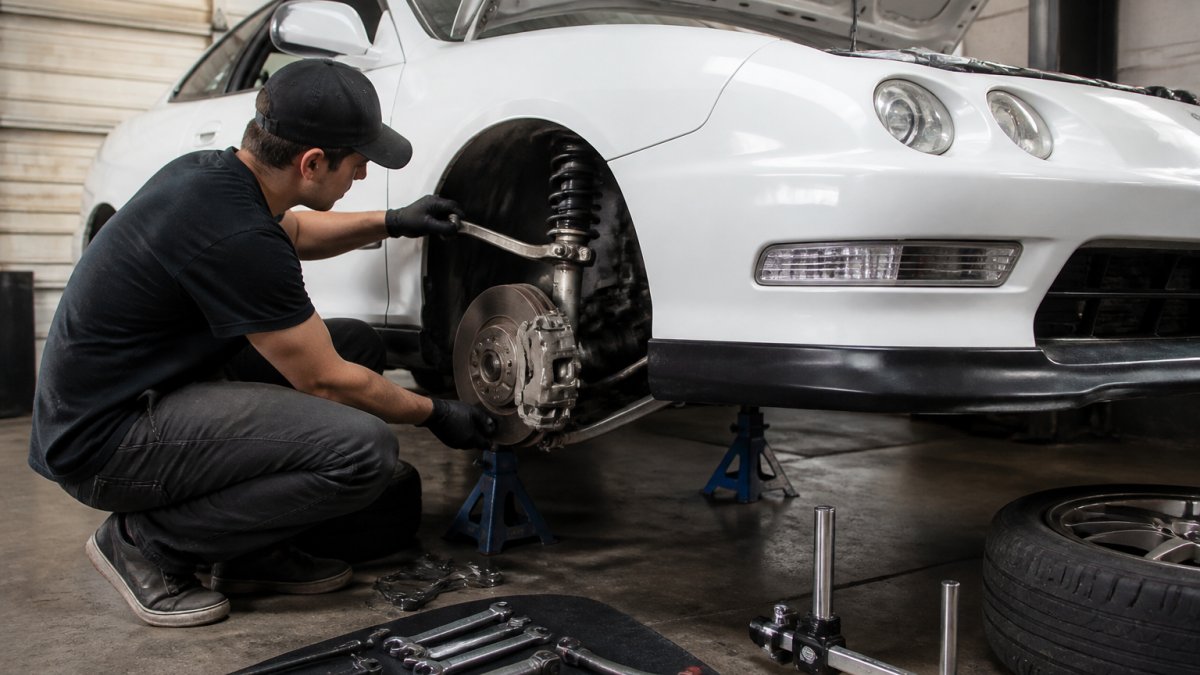
Starting ranges for a dual-purpose Integra
These are starting points for a car that sees street miles and track days. Dedicated track cars can go more aggressive; street-only cars should stay closer to factory.
| Setting | Street-biased | Dual-purpose | Track-biased | What it does |
|---|---|---|---|---|
| Front camber | -1.0 to -1.5° | -2.0 to -2.5° | -3.0 to -3.5° | More negative camber improves cornering grip but wears the inner shoulder on the street |
| Rear camber | -1.0 to -1.5° | -1.5 to -2.0° | -2.0 to -2.5° | More rear camber helps rotation but reduces straight-line braking stability |
| Front toe | 0 to slight toe-in | 0 to 1/16" toe-out total | 1/8" toe-out total | Toe-out sharpens turn-in but makes the car darty on the highway |
| Rear toe | Slight toe-in | 1/16" toe-in total | 1/16 to 1/8" toe-in total | Rear toe-in adds straight-line stability; too much kills rotation |
| Caster | Factory | Factory +0.5° | Factory +1.0° | More caster adds steering feel and camber gain in turns, at the cost of steering effort |
Why each setting matters
Camber is the wheel angle relative to vertical viewed from the front; negative camber tilts the top inward.
Toe is the wheel angle relative to the car's centerline viewed from above.
Caster is the steering axis angle viewed from the side. More positive caster adds steering weight and camber gain as the wheel turns, helping grip in long corners, at the cost of higher steering effort.
Adjustment range and hardware
The factory rear adjustment range often isn't enough once the car is lowered, because lowering changes static camber and consumes the eccentric bolt's travel. Adjustable rear camber arms let you reach the camber values discussed above.
Front camber adjustment depends on the coilover. Kits with adjustable camber plates, like the NEOMAX 2-Way, give you a range at the strut top; cars without them may need camber bolts or adjustable upper arms, depending on generation.
Generation-specific notes
- 3rd Gen (DB/DC2): Double-wishbone front and rear gives good camber gain under load, so you can run less static camber than a strut car and still get good tire temps. Rear camber is adjustable from the factory within a small range; lowered cars often need aftermarket arms to reach -2.0° or more.
- 4th Gen (DC5): MacPherson strut front end loses camber under load, so these cars typically want more static front camber than a DC2 to hit the same tire temps. Front camber plates are the usual solution.
- 5th Gen (DE4/DE5, including Type S): Confirm whether your coilover retains the factory top mount or replaces it with a camber plate. The Type S adaptive damper system may require a cancellation module, and alignment should be set after that is installed, not before.
Alignment is the last step, not the first
Set alignment after every suspension change that affects ride height or geometry, coilovers, camber arms, bushings, and bent or worn components. Guessing at toe after a camber change is how cars end up darty on the highway. Get a printout, log it, and change one setting at a time.
Reading Tire Temperatures and Lap Times to Tune Your Setup
Tire temperatures and lap times are the feedback loop that tells you whether your setup is working.
Start with tire pressures. If the inner shoulder runs much hotter than the outer, you likely have too much negative camber for that track.
Then look at lap times across a run. A change that makes the car feel sharper but slows your best lap is a downgrade.
A common mistake is changing three things at once. Change one, test, then decide.
Build Your Integra Track Suspension Package With Axion
Sorting a track suspension is a sequence, not a shopping spree, and the fast cars are the ones where each part supports the next.
We've been supplying JDM aftermarket components since 2009. If you're unsure whether a kit fits your build, ask before you order.
Ready to plan your build? Search our store for Integra suspension components and start with the stage that matches your car today.
Frequently Asked Questions
What suspension upgrades should I make first for an Acura Integra track car?
The Eibach 25mm Rear Sway Bar + Brace Kit is listed for the 5th Gen Acura Integra. The Torque Solution Adjustable Rear Camber Arms also fit the 5th Gen Acura Integra; the listing recommends professional installation and an alignment after installation.
Are coilovers worth it for an Acura Integra track build?
The SILVER'S NEOMAX 2-Way Coilovers fit the 5th Gen Acura Integra 1.5T. The listing describes height adjustment at the lower bracket, separate rebound adjustment with 40 clicks and compression adjustment with 24 clicks, and adjustable front camber plates on most MacPherson-style applications.
What alignment settings work well for an Acura Integra on track?
The Torque Solution Adjustable Rear Camber Arms fit the 5th Gen Acura Integra. The listing recommends professional installation and an alignment after installation.
Do I need to upgrade bushings and sway bars for track use?
The Eibach 25mm Rear Sway Bar + Brace Kit fits the 5th Gen Acura Integra. The Torque Solution Adjustable Rear Camber Arms also fit the 5th Gen Acura Integra, and their listing recommends professional installation and an alignment afterward.
How should I set up Acura Integra suspension for a track day?
Set tire pressures cold, note your damper clicks, and start with a conservative alignment. Run your first sessions at a moderate pace and check tire temperatures and wear across the tread. Adjust compression and rebound based on whether the car is unsettled over bumps or slow to take a set in corners. Log lap times and changes each session so you can tell which adjustment actually helped.
Will 11th Gen Civic suspension parts fit my 5th Gen Acura Integra?
The TEIN Flex Z Coilovers and Eibach 25mm Rear Sway Bar + Brace Kit listings both include the 5th Gen Acura Integra and 11th Gen Honda Civic in their fitment. Check the product listing for the specific vehicle fitment before ordering.
The hardest part of a track build isn't choosing parts, it's knowing which order to buy them in. Axion Performance Parts carries coilovers, camber arms, sway bars, and brake pads that are designed to work as a system, with technical support from people who have built these cars. Get started with Axion Performance Parts and build a suspension package that rewards you every session.


