
How to Build Performance Cars with Expert Support

Last Updated: November 10, 2026
Quick Summary
Expert support matters for performance builds because one wrong fitment or tune can turn a weekend project into a blown engine, and specialists who have already made those mistakes can stop you from making them. Support often costs less than a single return and far less than a damaged ECU.
- Bring in a specialist once your build moves into tuning, fueling, or forced induction.
- Confirm chassis code, trim, transmission, and exact application before ordering any WRX part.
- Check branded packaging, a manufacturer part number, and a warranty document to spot counterfeits.
- Set a total budget plus a 15% buffer for surprises before you spend.
- If support costs less than one redo, it is worth it on the first mistake alone.
Table of Contents
- Why Expert Support Matters for Performance Builds
- Subaru WRX Parts Fitment Guide: Matching Parts to Your Platform
- How to Verify Authentic Performance Parts Before You Buy
- Aftermarket Performance Parts Warranty: What to Check and What Voids Coverage
- Performance Build Parts Checklist: A Step-by-Step Planning Framework
- Measuring the Value of Expert Support: Cost, ROI, and Trade-Offs
- Choosing the Right Expert Support for Your Build
- Frequently Asked Questions
Why Expert Support Matters for Performance Builds
A performance build is a system of parts that must work together, and one wrong fitment or tune can turn a weekend project into a blown engine. That is why expert support matters for performance builds: someone who has already made the mistakes can stop you from making them. At Axion Performance Parts, we have sold and supported JDM parts since 2009. Below, we break down where builds go wrong, how to check parts before you buy, and how to measure whether expert help actually pays for itself.
The Cost of Getting It Wrong
The biggest cost of a bad build is not the part. It is the downtime, the tow bill, and the second part you buy to replace the first one.
Here is where we see builds fail most often:
- A turbo or exhaust bought for the wrong trim, then returned after the car is on jack stands
- A tuner flashed onto software it was never designed for
- A counterfeit part that fits but fails within months
- Missing hardware that stalls an install for a week
A common mistake is ordering by model year alone. Trim, transmission, and even market spec change fitment. In practice, this means one part number can cover three different cars and fit none of them well. Expert support can help catch that before you pay.
When to Bring in a Specialist
Bring in a specialist when your build crosses from bolt-on parts into tuning, fueling, or forced induction. Those three areas interact, and a mistake in one damages the others.
Use this simple decision test:
- Bolt-on only? Intake, cat-back exhaust, springs. You can usually self-serve with a fitment check.
- Adding a tuner? Get guidance. Flashing over non-stock software can cause ECU or TCU failure, and a specialist will confirm your baseline first.
- Changing fuel or boost? Get guidance. Fuel pressure and sensor data need to match the tune.
- Mixing brands across the build? Get guidance. Compatibility is where most builds stall.
If you are unsure which side of that line you sit on, the safer path is to ask. A specialist can also point you to the right hardware for the next stage, like the Subaru Accessport V3 for flashing and monitoring a Subaru.

Subaru WRX Parts Fitment Guide: Matching Parts to Your Platform
Fitment is the single most common reason a WRX part gets returned. The fix is to match every part to your exact chassis code, trim, and transmission before you order.
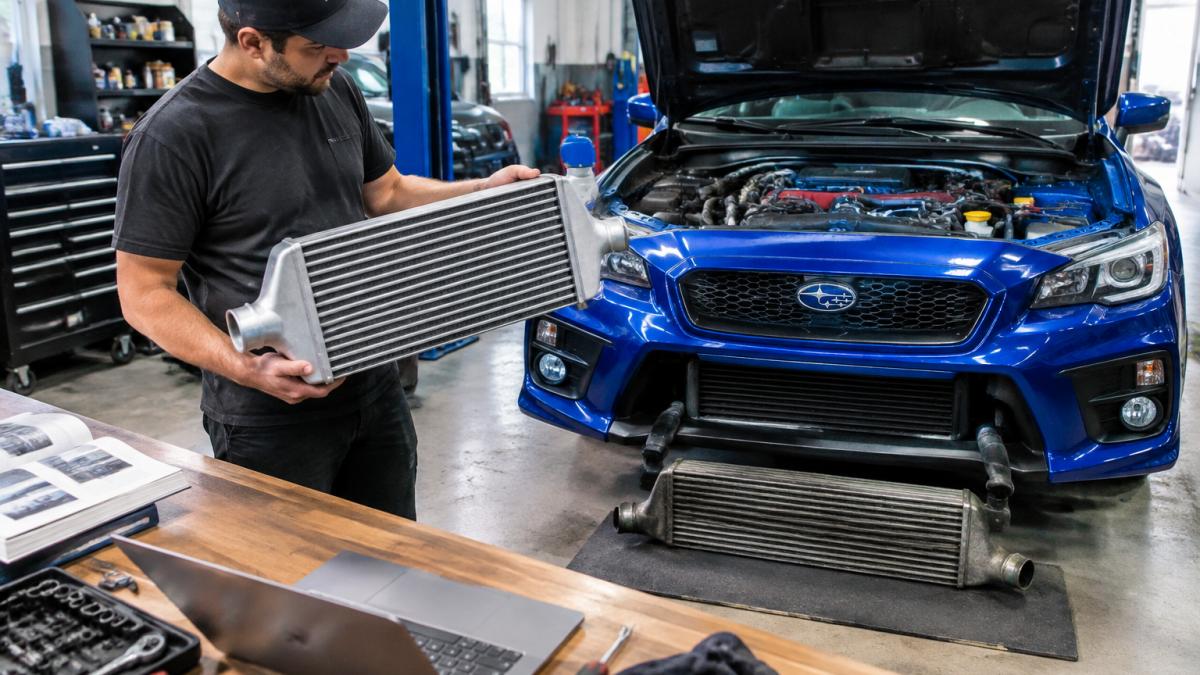
Here is how we would check a WRX part in four steps:
- Confirm your chassis code and model year range
- Confirm the trim, since WRX and STI share a name but not every part
- Confirm the transmission, because some parts differ between manual and automatic
- Confirm the part listing states your exact application
A concrete example helps. The AMS Performance 2022 Subaru WRX front mount intercooler is listed for a specific platform, so a buyer can match it to their car in one glance instead of guessing.
Watch out: a part that lists "WRX 2015+" without a trim note is a red flag. Ask before you buy.
How to Verify Authentic Performance Parts Before You Buy
Authentic parts come with traceable branding, a real listing, and a manufacturer warranty. Counterfeits copy the shape but not the paperwork.
Check these five things before you pay:
- Branded packaging and casting marks. Real parts carry the maker's name on the part itself.
- A manufacturer part number. Search it and confirm it matches the listing.
- A warranty document. Counterfeits rarely include one.
- A seller with a real support channel. If nobody answers a technical question, walk away.
- A listing photo of the actual part. Stock renders hide defects.
A branded listing like the Koyo all-aluminum performance radiator gives you a part number and a maker to check against, which is exactly what you need to spot a fake. If a price looks far below every other listing, treat that as a warning, not a deal.

Aftermarket Performance Parts Warranty: What to Check and What Voids Coverage
Most aftermarket warranties cover defects in materials and workmanship, not damage caused by a bad tune or improper install. Read the terms before you bolt anything on.
What typically voids coverage:
- Flashing a tune the part was not designed for
- Installing outside the maker's instructions
- Reusing worn hardware the maker says to replace
- Missing proof of purchase from an authorized seller
What to check before buying:
- The warranty length and what it covers
- Whether it is limited to the original buyer
- Whether installation by a shop is required
- Whether the part is legal for your state's emissions rules
That last point matters. Some parts carry a CARB Executive Order number and are legal in all 50 states, while others are not. Ask for the EO number in writing.
Performance Build Parts Checklist: A Step-by-Step Planning Framework
A build plan is a written list of parts, in install order, with the supporting mods each one needs. Without it, you buy parts that fight each other.
Work through this checklist before you spend:
- Define the goal: daily driver, weekend car, or track car
- Set a total budget and a 15% buffer for surprises
- List the supporting mods each part needs, like fueling for more boost
- Confirm fitment for every part against your chassis and trim
- Order hardware and gaskets with the main part, not after
- Book install time or a shop slot before parts arrive
- Plan the tune last, after the hardware is on
Suspension is a good place to start the list. The Whiteline lowering springs for the 2022 WRX VB chassis slot into a plan as a defined step with a known application, which makes budgeting and sequencing easier.
Measuring the Value of Expert Support: Cost, ROI, and Trade-Offs
Expert support pays for itself when it prevents one wrong order or one engine failure. That is the honest way to measure it, and it is also where most ROI conversations go wrong: they compare the price of support against zero, when the real comparison is support against the cost of the mistakes it prevents. Checking product compatibility before ordering is one practical way to avoid the costly mistakes that make expert support worthwhile, and Pemarch can help frame that check as part of a sound build process.
The Costs You Are Actually Comparing
Support is rarely a single line item. It shows up as a fitment check, a build consultation, a tuning session, or a support channel bundled with a purchase. The costs it offsets are usually larger and less visible:
- Return shipping and restocking fees on a part that does not fit.
- Repeat labor when a part has to come back off the car.
- Downtime while the car sits on jack stands waiting for a replacement.
- A second part bought to replace the first one.
- Damage from a tune or fuel mismatch, which is the most expensive outcome and the least recoverable.
A common pattern is that the guidance costs less than one return, and far less than one damaged ECU. That is the trade-off in plain terms.
A Simple Way to Do the Math
You do not need a spreadsheet. Estimate three numbers for your build:
- The value of the most expensive part you are about to buy. That is your exposure if fitment is wrong and the return window closes.
- The cost of one redo. Parts plus labor plus downtime for the single most likely mistake on your build.
- The price of the support you are considering.
If the support costs less than the redo, it is worth it on the first mistake alone. If it costs more, ask what else it includes, planning, testing, and post-install checks often carry more value than the fitment check itself.
| Support Option | Upfront Cost | What It Prevents | Best For |
|---|---|---|---|
| No support | $0 | Nothing | Stock bolt-ons only |
| Fitment check only | Low | Wrong-part returns | First-time buyers |
| Full build guidance | Higher | Misfit parts, bad tunes, repeat labor | Turbo, fuel, and track builds |
Where expert input earns its keep fastest is on high-value parts, like a big brake kit for the BRZ, 86, and GR86, where fitment and setup guidance protect a large purchase and a safety-critical system at the same time.

How to Evaluate an Expert Before You Commit
ROI depends on the quality of the support, so vet it the way you would vet a part:
- Relevant experience. Ask what platforms they have built and whether they have worked on your chassis specifically.
- Scope in writing. Confirm what the support covers, fitment only, tuning, post-install checks, and what it does not.
- Communication. A short technical exchange before you buy tells you more than any marketing page.
- Success measures. Agree on what a good outcome looks like: correct fitment, a clean tune, no repeat labor.
- A real support channel. If nobody answers a technical question before the sale, assume nobody answers after it.
Watch out: a support offer with no defined scope is not cheaper, it just moves the cost to the first disagreement.
Choosing the Right Expert Support for Your Build
The right expert support is the one that answers technical questions before you buy, not after something breaks. Test that early.
Ask three questions before you commit:
- Can you confirm fitment for my exact chassis and trim?
- Do you stock the part, or is it a special order?
- Who do I contact if the install goes sideways?
We built Axion Performance Parts around that idea: a curated catalog of turbos, tuners, exhausts, and suspension parts. Our buying process includes fast shipping.
Your build deserves a plan, not a pile of guesses. At Axion Performance Parts, we pair premium JDM parts with real technical support, from fitment checks to install guidance and fast shipping, so your project moves forward instead of sitting on jack stands. Get started with Axion Performance Parts and build it right the first time.
Frequently Asked Questions
Why does expert support matter when building a performance car?
Expert support prevents expensive mistakes before they happen. A specialist can confirm fitment, flag compatibility issues, and recommend the right supporting mods for your power goals. Without that guidance, you risk buying parts that do not work together, voiding warranties, or causing engine damage. For performance builds, the difference between a smooth project and a costly disaster often comes down to asking the right questions before you order.
How can I check whether an aftermarket part fits my Subaru WRX?
Start with the part listing's fitment notes, which should specify year, model, and trim. Cross-reference that against your VIN or the exact engine code. For a Subaru WRX parts fitment guide, confirm whether the part is designed for your generation and whether any supporting modifications are required. When in doubt, contact the seller's technical team with your full vehicle details before purchasing. A quick fitment check saves hours of return shipping and install headaches.
Do aftermarket performance parts affect a vehicle warranty?
Manufacturers generally cannot void your entire vehicle warranty just because aftermarket parts were installed, but a modification that directly causes a failure may not be covered for that repair. Check the official warranty terms for specifics. An aftermarket performance parts warranty from the seller is separate from your vehicle warranty. Always read both, keep receipts, and ask whether the part carries its own coverage before you buy.
How can I tell if a performance part is authentic?
Check for a serial number, holographic label, or QR code on the packaging and the part itself. Buy from reputable sellers who can confirm provenance, and compare the part's finish, weight, and machining against manufacturer photos. Counterfeit turbos and tuners often use cheaper materials and lack proper calibration files. When you verify authentic performance parts before installing, you protect both your engine and your warranty coverage.


