
How to Set Performance Parts Technical Support Expectations

Last Updated: October 26, 2026
Quick Summary
Performance parts technical support expectations are the standards a seller should meet before, during, and after your purchase: an initial reply within one business day, a fitment answer within two, and first-contact resolution from someone with real technical knowledge. Ask for these terms in writing before you order.
- Order support handles tracking and returns, while technical support covers fitment, compatibility, installation, and troubleshooting.
- Send your VIN, current mods, and intended use in one message to get fitment help before ordering.
- Document symptoms, codes, install photos, and your full mod list before contacting support.
- Escalate in writing and reference your original ticket so your history stays attached.
- Axion Performance Parts has specialized in JDM aftermarket parts since 2009.
Table of Contents
- What Good Performance Parts Technical Support Looks Like
- Getting Performance Parts Fitment Help Before You Order
- Performance Parts Troubleshooting: A Step-by-Step Workflow
- Aftermarket Parts Warranty Coverage: What Should Be Covered
- How to Contact Performance Parts Customer Support and Escalate
- A Practical Service-Level Agreement for Performance Parts Support
- Search Axion's Store for Parts Backed by Real Technical Support
- Frequently Asked Questions
What Good Performance Parts Technical Support Looks Like
Performance parts technical support expectations start with the help a parts seller gives you before, during, and after a purchase to make sure the component fits your car, works with your build, and gets installed correctly.
The expectations you should set are concrete. Response times, who actually picks up, and what counts as a real answer, not a canned reply.
Response Times and First-Contact Resolution
A reasonable standard: an initial reply to a technical question within one business day, and a fitment answer within two. First-contact resolution is the metric that matters most. It means the first person who answers can actually resolve your question instead of forwarding it.
Many enthusiasts find that order-status questions get answered quickly while technical questions stall. That gap is the tell. A seller with real technical knowledge on staff closes it.
The Difference Between Order Support and Technical Support
Order support handles tracking, address changes, and returns. Technical support handles fitment data, compatibility, installation guidance, and troubleshooting. They are different jobs and often different people.
When you call about a suspension upgrade that clunks, an order agent cannot help you. Ask up front which team you are reaching, and expect to be transferred to a technician or service advisor who knows the platform.
Getting Performance Parts Fitment Help Before You Order
Fitment help is the pre-purchase check that confirms a part matches your exact vehicle application: year, trim, engine, and any existing modifications. Get it in writing before you pay.
Here is how to get solid performance parts fitment help:
- Send your VIN, current mods, and intended use in one message
- Ask for the specific technical specifications: dimensions, mounting points, and material standards
- Request confirmation that the part works with your existing tuner or suspension
Watch out: a vague "yes it fits" reply is not fitment help. You want the part number, the application it was verified against, and the name of who confirmed it. That record protects you if the part arrives wrong.
Performance Parts Troubleshooting: A Step-by-Step Workflow
Troubleshooting works best as a fixed sequence, not a guessing game. Follow the same order every time so you can rule out causes and give support a clear picture.
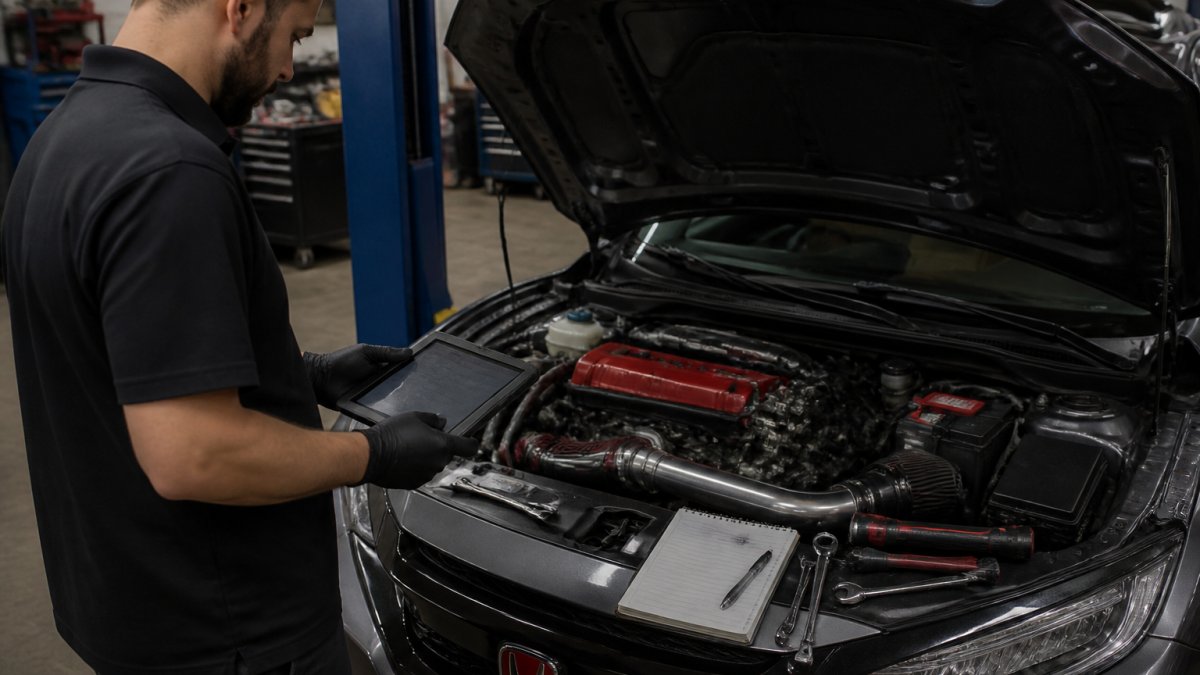
- Confirm the symptom. Write down exactly what happens, when, and under what conditions. Note whether it appears at cold start, under load, at a specific RPM, or only after a certain drive time. For track-use issues, log the session, lap, and ambient conditions.
- Check the install. Re-verify torque specs, connections, and that every supplied part went on. Confirm the part number on the box matches the part number on the vehicle. A surprising share of "defective part" claims trace back to a missing bracket, a reversed connector, or a gasket left in the packaging.
- Scan for codes. Pull diagnostic codes before touching anything else. Save the freeze-frame data if your scan tool captures it. Clear codes only after you have recorded them, never before.
- Isolate the part. Confirm whether the issue follows the new component or existed before. If you still have the original part, a swap-back test is the fastest way to isolate. On a modified vehicle, change one variable at a time.
- Compare to baseline. Note what changed since the part went on. Include the tune revision, fuel, ambient temperature, and any other parts installed in the same window. Performance issues are often interaction issues, not single-part failures.
- Contact support with your evidence. Send the documented steps, not just "it's broken." A support request that includes the symptom log, codes, and install photos gets routed to a technician instead of a returns clerk.
Performance-Specific Scenarios to Rule Out
Before you escalate, run through the scenarios that are unique to performance builds. These are the ones generic troubleshooting guides skip, and the ones that most often turn out to be the real cause.
- Tune and calibration conflicts. A part installed without a matching tune revision can trigger lean conditions, knock, or drivability complaints that look like hardware failures. Confirm the tune was updated for the new part before you blame the part.
- Interacting aftermarket components. An intake, downpipe, and tune are a system. A change to one can push another out of its intended operating range. List every aftermarket part in the affected system, not just the newest one.
- Modified-vehicle variables. Suspension geometry, ride height, wheel and tire size, and weight reduction all change how a part behaves. A clunk after a coilover install may be an alignment or preload issue, not a damper defect.
Keep a build log. A simple notebook or spreadsheet with part numbers, install dates, tune revisions, and any symptoms gives support a complete history in one place. Builds with a log get resolved faster because the technician can see the whole system, not just the latest complaint.
What to Document Before You Call
Documentation is what separates a fast resolution from a week of back-and-forth. Before you contact anyone, gather:
- Photos of the installed part and any damage
- Your order number and the part number
- Diagnostic codes and when they appear, plus freeze-frame data if available
A support request with this attached gets resolved faster because the service department does not have to ask you six follow-up questions. It also creates a record if the issue turns into a warranty claim.
Do not clear diagnostic codes before recording them, and do not swap multiple parts at once hoping one fixes the issue. Both destroy the evidence a technician needs to diagnose the real cause.
Aftermarket Parts Warranty Coverage: What Should Be Covered
Aftermarket parts warranty coverage should protect you against manufacturing defects for a defined period, and the terms should be stated plainly before you buy.
A fair policy covers defects in materials and workmanship. It typically does not cover damage from improper installation, abuse, or unrelated modifications, and that is reasonable.
Get the warranty length and claim steps in writing at purchase.
How to Contact Performance Parts Customer Support and Escalate
Contact support through the channel that creates a written record: email or a support portal, not a phone call alone.
Start with the standard channel and include your documentation. If you do not get a real answer within the stated response time, escalate in writing and reference your original ticket.
Escalation should move up one level, not restart from scratch. A good service workflow keeps your history attached so you never repeat yourself.
A Practical Service-Level Agreement for Performance Parts Support
A service-level agreement for performance parts support is a written promise of how fast and how well a seller responds to technical questions. Most sellers do not publish one. Ask for these terms anyway, and hold them to it. The framework below turns vague support quality into a standard you can measure before and after you buy.
The Four Terms That Matter
A usable support agreement covers four things: response-time targets, support hours, escalation paths, and resolution expectations. Response times tell you how fast the first reply arrives. Support hours tell you when anyone is actually available. Escalation paths tell you who to reach when the first reply does not solve the problem. Resolution expectations tell you what counts as fixed, not just answered.
| Support Standard | What to Expect | Why It Matters |
|---|---|---|
| Initial response | Within 1 business day | Keeps your build moving |
| Fitment answer | Within 2 business days | Prevents wrong-part orders |
| Support hours | Stated in writing, including time zone | Tells you when a real person is available |
| Escalation reply | Within 1 business day of escalation | Stops silent stalls |
| Named escalation contact | A person, not a queue | Removes the re-explaining loop |
| Warranty claim decision | Clear timeline in writing | Removes guesswork |
| Parts returns window | Stated before purchase | Protects your money |
Support Hours and Channel Expectations
Ask which hours support is staffed and in which time zone. A seller that answers email at midnight but has no technician on duty until Monday is not offering technical support on the weekend, no matter what the autoresponder says. Match your channel to the question: fitment and pre-purchase questions fit email or a portal because they need a written record; urgent install-stopping issues fit phone or chat during staffed hours; warranty claims fit the portal so the history stays attached.
Escalation Paths
Escalation should move up one level, not restart from scratch. A workable path looks like this: first-line support answers within the initial response target; if the issue is not resolved, you escalate in writing and reference your original ticket; the escalation goes to a named technician or service advisor with a resolution date. A good service workflow keeps your history attached so you never repeat yourself.
Resolution Expectations
Define what "resolved" means before you need it. For a fitment question, resolved means a written confirmation with the part number and the application it was verified against. For a troubleshooting issue, resolved means a diagnosis and a next step, whether that is a replacement, a return, or an installation correction. For a warranty claim, resolved means a decision with a timeline.
These standards map to real key performance indicators like resolution rate, customer satisfaction scores, and customer retention. A seller tracking those numbers cares about customer satisfaction. One that cannot state a single standard is guessing, and so are you. Ask for the four terms in writing before you order, and keep the reply with your build log.
Search Axion's Store for Parts Backed by Real Technical Support
The gap between a parts seller and a build partner comes down to support you can measure. Set your performance parts technical support expectations before you order, ask for fitment confirmation in writing, and document every issue.
Axion Performance Parts has specialized in JDM aftermarket parts since 2009, with expert support from people who actually modify cars. We offer fast shipping, a curated selection of turbos, tuners, exhausts, and suspension upgrades, and a simplified shopping experience built for enthusiasts.
Frequently Asked Questions
What information should I provide when asking for performance parts support?
Send the year, make, model, trim, and any existing modifications, plus the part number or order number. Include photos of the install area, the exact symptom, and any codes you pulled with a scanner. The more complete the support request, the faster a technician can confirm fitment or diagnose the issue. Missing vehicle application details are the most common reason a performance parts support ticket stalls for days.
Can technical support help confirm whether a part fits my vehicle?
Yes, and performance parts fitment help should go beyond a vehicle selector. A good support team checks dimensions, material standards, and compatibility with your current setup, including custom work. On an 11th Gen Civic with existing suspension or tuner changes, ask specifically whether the part was validated on a car with those mods. Get the answer in writing before you order so a mid-install surprise does not become your problem.
Does installing aftermarket performance parts affect a warranty?
Aftermarket parts warranty coverage is separate from your vehicle's factory warranty, and the two are governed differently. A manufacturer can only deny a factory claim if the aftermarket part caused the failure, which is why documentation matters. Keep receipts, install photos, and any tuner logs. Ask the seller what their own warranty length covers, whether labor is included, and what evidence a warranty claim requires before you buy.
How do I troubleshoot an aftermarket performance part that is not working?
Start with the basics: recheck connectors, torque specs, and clearances, then scan for codes and log a baseline run. Write down what changed, when the symptom appears, and whether it is constant or intermittent. Contact performance parts customer support with that record and photos. A structured troubleshooting workflow, rather than a vague complaint, is what gets a resolution instead of a back-and-forth about whether the part was installed correctly.


