
Best Aftermarket Exhausts for Honda Civic Si

Table of Contents
- Why the Right Civic Si Exhaust Changes Everything
- Quick Comparison: Civic Si Cat-Back Exhaust Options
- Best-Sounding Civic Si Exhaust Systems for Every Taste
- 11th-Gen Civic Si Exhaust Fitment and What Fits Your Model Year
- Civic Si Exhaust Installation: What to Expect in the Garage
- Drone, Emissions, and Daily Driving: What Nobody Tells You
- How to Choose the Best Aftermarket Exhaust for Your Civic Si
- Frequently Asked Questions
Last Updated: October 16, 2026
Why the Right Civic Si Exhaust Changes Everything
The factory exhaust on the 11th-gen Civic Si is a compromise, tuned for emissions, cabin quiet, and mass production, not for the driver who wants to hear the 1.5L turbo. Swapping to one of the best aftermarket exhausts for Honda Civic Si owners actually enjoy is the most satisfying bolt-on you can make.
At Axion Performance Parts, we have stocked Civic and Integra exhaust systems since 2009, and the pattern never changes: sound is what buyers ask about first, fitment second, and drone is what makes them regret a purchase.
Aftermarket exhaust refers to any system sold outside the factory parts channel, replacing some or all of the stock piping, resonators, and mufflers. A cat-back exhaust replaces everything from just behind the catalytic converter to the tailpipes.
The systems below all fit the 11th-gen Civic Si (FE1, 2022 and newer) unless noted. Every price is what we charge today.
Quick Comparison: Civic Si Cat-Back Exhaust Options
The best Civic Si cat-back exhaust for you depends on whether you value a deep, controlled tone or maximum volume.
| System | Price | Sound Character | Best For |
|---|---|---|---|
| Invidia 70mm N1 | $939.33 | Loud, raw, classic N1 | Budget builds, track days |
| Invidia Dual Q300 | $989.60 | Deep, refined, mild | Daily driving |
| MBRP Street Profile | $1,259.99 | Aggressive on throttle | Highway plus back roads |
| AWE Track Edition (10th Gen) | $1,225.00 | Very loud, rowdy | 10th-gen owners only |
| AWE FWD Track Edition | $1,325.00 | Loud, straight-through | Enthusiasts who want volume |
| APEXi N1-X Evo Extreme | $1,399.00 | Sharp, titanium-tipped | Show and track mix |
| Thermal R&D Front Pipe Back | $1,399.99 | Smooth, drone-controlled | Long commutes |
| aFe POWER Takeda | $1,457.40 | Deep, full-bodied | Buyers who want it all |
| AWE Touring Edition | $1,595.00 | Sophisticated, drone-free | Daily drivers who hate drone |
| MagnaFlow NEO Series | $1,727.00 | Balanced, no-drone tech | Premium daily setup |
Best-Sounding Civic Si Exhaust Systems for Every Taste
Sound is subjective, so treat this as a map rather than a ranking.

The Invidia 70mm N1 is the value pick at $939.33, delivering the classic N1 rasp: sharp, metallic, and unmistakable at wide-open throttle.
The Invidia Dual Q300 at $989.60 takes the opposite approach: its flat-bottom muffler and continuous internal piping produce a rich, deep note that stays composed in traffic.
For something in between, the MBRP Street Profile at $1,259.99 is aggressive on throttle, calm on a long drive.
Deep Growl vs. Aggressive Rasp: What to Expect
A deep growl comes from larger piping, a resonator, and a muffler that smooths high frequencies; rasp comes from thin piping, minimal muffling, and high-RPM resonance. For a low, chesty note, look at the Invidia Q300, Thermal R&D, or MagnaFlow NEO. For aggressive rasp, the Invidia N1 and AWE Track Edition deliver it.

11th-Gen Civic Si Exhaust Fitment and What Fits Your Model Year
Fitment is where online exhaust shopping goes wrong. A Civic Si exhaust is not a universal part: chassis, rear subframe, hanger locations, and tip spacing all change between generations, and a system that bolts cleanly onto one model year can leave a rattling midpipe or crooked tips on another.
Generation-by-Generation Fitment Reference
| Generation | Model Years | Chassis Code | Engine | Exhaust Fitment Notes |
|---|---|---|---|---|
| 8th Gen Si | 2006-2011 | FA5 (sedan) / FG2 (coupe) | K20Z3 2.0L | Coupe and sedan rear sections differ. Confirm body style before ordering. |
| 9th Gen Si | 2012-2015 | FB6 (sedan) / FG4 (coupe) | K24Z7 2.4L | Coupe and sedan again differ at the rear. Hanger points are unique to this chassis. |
| 10th Gen Si | 2017-2021 | FC1 (sedan) / FC3 (coupe) | L15B7 1.5L turbo | Different rear section and tip spacing than the 11th gen. Systems are not interchangeable. |
| 11th Gen Si | 2022+ | FE1 (sedan) | L15BA 1.5L turbo | Current car. Shares its platform with the 5th-gen Acura Integra. |
| 5th Gen Integra | 2023+ | DE4 | L15CA 1.5L turbo | Shares the FE1 platform, so most 11th-gen Si cat-back systems bolt on directly. |
Two patterns matter most. First, within a single generation, coupe and sedan rear sections are often different parts, a sedan system may not fit the coupe even in the same model year. Second, the 11th-gen Si and 5th-gen Integra share the FE1/DE4 platform, which is why so many listings name both cars. If a listing names only the Integra but the platform matches, it will usually fit the Si, but confirm tip spacing and hanger points first.
10th Gen vs. 11th Gen: Key Differences
The 10th-gen Si (2017-2021) and 11th-gen Si (2022+) do not share exhaust fitment: pipe routing, hanger locations, and tip spacing differ, so buying one for the other will not work without fabrication. The AWE Track Edition at $1,225.00 is built specifically for the 10th gen. Every other system in this guide fits the 11th gen directly.
How to Verify Fitment Before You Buy
- Match the chassis code, not just the model year. FE1 for the 11th-gen Si, FC1 or FC3 for the 10th gen, DE4 for the 5th-gen Integra.
- Confirm body style. Coupe and sedan rear sections differ on the 8th and 9th gens, and tip spacing can differ within a generation.
- Check the front-pipe interface. Some systems mate only with the factory front pipe. If you run an aftermarket front pipe, verify the flange style matches.
Civic Si Exhaust Installation: What to Expect in the Garage
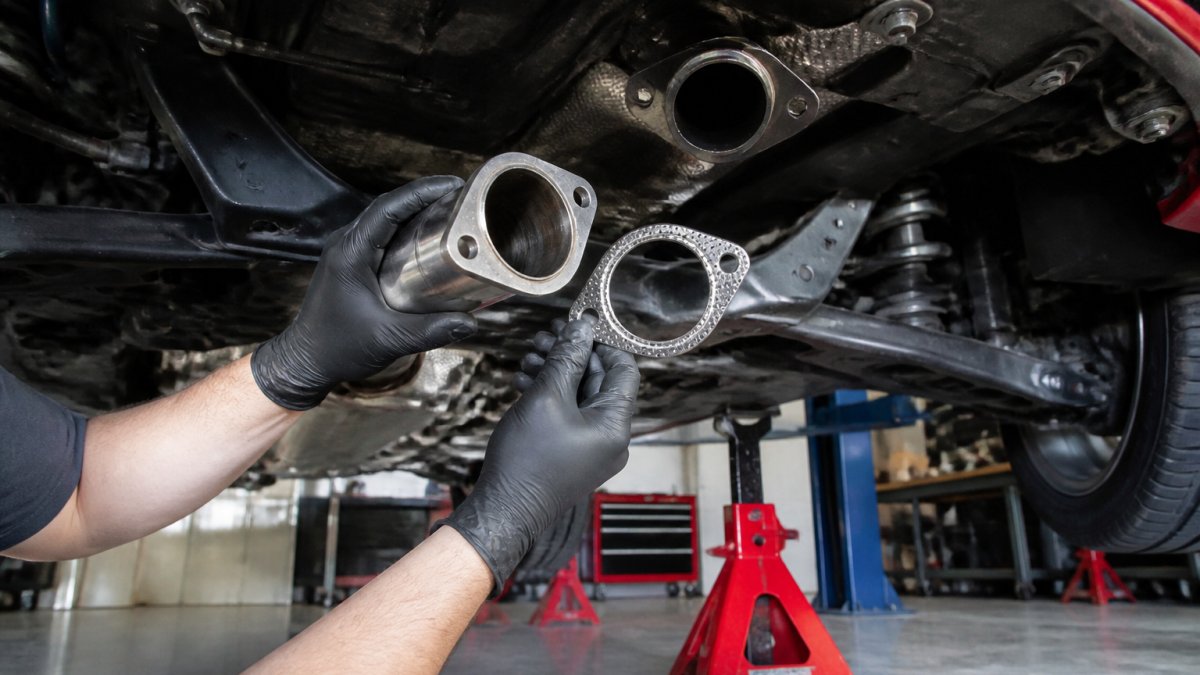
Most cat-back exhausts are a direct bolt-on job a patient DIYer can finish in a driveway in a few hours. The factory flange and hanger points are reused, so no cutting or welding is required.
AWE Tuning Catback Exhaust FWD Touring Edition →
The AWE Touring and Track editions install without removing the motor mount. The aFe Takeda uses a factory-style flange and hangers for a no-cut install, and Thermal R&D includes compression clamps for fine-tuning alignment.
Budget two to three hours for a first-time cat-back install. The job is straightforward, but aligning the tips so they sit evenly in the bumper cutout is the part that eats time. Loosen every clamp, center the tips, then tighten from front to back.
Drone, Emissions, and Daily Driving: What Nobody Tells You
Drone is the low, humming resonance that fills the cabin at highway speed, and it is the number one reason people sell an exhaust they loved on day one. It is not the same as volume: a loud exhaust can be drone-free, and a quiet one can drone badly if its resonators are tuned wrong.
What Actually Causes Drone
Every exhaust has resonant frequencies, RPM ranges where pipe length and volume reinforce sound waves instead of cancelling them. On a Civic Si, the worst drone shows up in the 2,000-3,000 RPM band, exactly where the car sits at 65-75 mph in top gear.
This is why real drone control costs more. The AWE Touring Edition at $1,595.00 uses AWE's patented 180 Technology resonator. The MagnaFlow NEO Series at $1,727.00 uses dual No Drone Technology resonators.

Matching the System to Your Commute
- Mostly city driving under 45 mph: Drone is rarely an issue. Almost any system in this guide is livable.
- Regular 30-60 minute highway commutes: Prioritize a system with a tuned resonator. AWE Touring, MagnaFlow NEO, and Thermal R&D are the safest picks.
- Long road trips or passengers who hate noise: Stick with the drone-controlled systems. The AWE Track Edition and Invidia N1 will wear on you over a multi-hour drive.
Emissions and Inspection: What a Cat-Back Does and Does Not Change
A cat-back exhaust replaces piping behind the catalytic converter, so it does not remove or alter the converter itself. That keeps you compliant in most states, since the converter and upstream oxygen sensors are untouched. What a cat-back can change is noise level, and that is where state and local rules come in.
- State noise limits. Many states set a maximum sound level for passenger vehicles, often measured at a set distance and RPM. A track-focused system can exceed those limits.
- Inspection procedures. Some states include a visual or sound check in the annual safety inspection. A cat-back that keeps the factory converter usually passes the emissions portion, but a loud system can still fail a noise check.
- California emissions notes. The aFe Takeda states it does not require a CARB EO number. The MBRP system carries a California Proposition 65 warning for nickel and chromium, a materials disclosure, not an emissions issue.
Total Cost of Ownership: What the Sticker Price Misses
- Installation. A shop typically charges a few hours of labor. A DIY install costs only time and jack stands.
- Gaskets and hardware. Most systems include what you need, but a fresh flange gasket is cheap insurance against leaks.
- Front pipe or downpipe (optional). If you later add a downpipe and tune, budget for both. A cat-back alone does not require them.
How to Choose the Best Aftermarket Exhaust for Your Civic Si
- Daily driver, want zero drone: AWE Touring Edition or MagnaFlow NEO Series.
- Daily driver who wants a deep tone with some attitude: Invidia Q300 or Thermal R&D.
- Weekend car and occasional track use: MBRP Street Profile or aFe Takeda.
On performance: a cat-back alone does not add huge power. The AWE systems are dyno-proven for gains of up to +10 hp and +7 lb-ft of torque at the wheels, a realistic expectation on a factory tune.
Daily drivers who want a deeper tone without giving up cabin comfort at highway speed. Start with the AWE Touring Edition or MagnaFlow NEO Series and skip the track-focused options.
Choosing an exhaust for your Civic Si comes down to three questions: how loud do you want it, can you live with it on a two-hour drive, and does it fit your exact model year.
Frequently Asked Questions
Which exhaust systems fit the 11th-generation Honda Civic Si?
Several cat-back systems fit the 11th-gen Civic Si (FE1, 2022+). Options include the AWE Tuning Touring Edition at $1,595, the AWE Track Edition at $1,325, the MagnaFlow NEO Series at $1,727, the MBRP Street Profile at $1,259.99, the Invidia N1 at $939.33, the Invidia Q300 at $989.60, the aFe POWER Takeda at $1,457.40, the APEXi N1-X EVO at $1,399, and the Thermal R&D Front Pipe Back at $1,399.99. All are direct bolt-on designs for the 1.5T engine.
Will an aftermarket exhaust improve Civic Si performance?
Yes, a cat-back exhaust can improve exhaust flow and produce measurable gains. The AWE Tuning systems for the 11th-gen Civic Si are dyno-proven to deliver up to +10 horsepower and +7 lb-ft of torque at the wheels. Larger pipe diameters like 3-inch and 2.5-inch mandrel-bent tubing reduce backpressure compared to the factory system, which supports both horsepower and torque. Pairing an exhaust with a tuner or intake can amplify results further.
How can I reduce exhaust drone in a Civic Si?
Choose a system with built-in drone cancellation. The AWE Tuning Touring Edition uses patented 180 Technology to cancel drone frequencies. The MagnaFlow NEO Series includes dual No Drone Technology resonators. The Thermal R&D system uses True Helmholtz Technology with internal chambers. These designs keep cabin noise comfortable at highway cruising speeds while still delivering an aggressive exhaust note under throttle. If drone is your main concern, avoid straight-through Track Edition designs.
What other performance mods pair well with a Civic Si exhaust?
An aftermarket exhaust works best alongside an intake, a downpipe, and a tuner. A high-flow intake complements the increased exhaust flow, while a tuner can adjust fuel maps to take advantage of the reduced backpressure. For 11th-gen Civic Si owners, a cat-back exhaust plus a tuner is a common starting combination. Suspension upgrades also pair well for drivers who want balanced performance improvements beyond just power.
Do Civic Si exhaust systems differ by model year or generation?
Yes. The 10th-gen Civic Si (2017-2021) and the 11th-gen Civic Si (2022+) have different underbody layouts and exhaust routing. For example, the AWE Tuning Track Edition for the 10th gen is a separate part from the 11th-gen version. Always confirm fitment for your specific generation and body style before ordering. Most manufacturers list the exact model years and chassis codes their systems are designed for.

